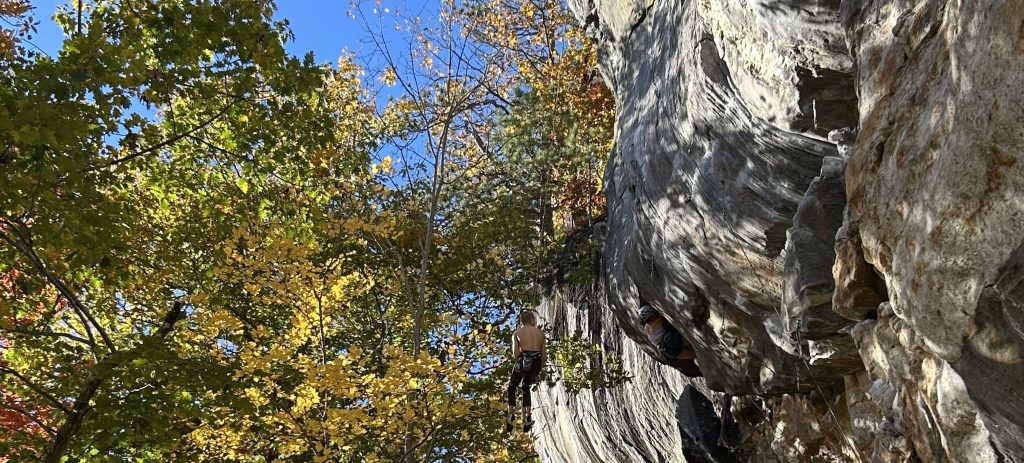
Recently, I’ve been on a quest for knowledge. As someone who’s coached teens for years, I’ve seen firsthand how difficult it can be to separate life from competition. Today’s youth grow up immersed in social media, often surrounded by hundreds of peers online. These platforms nurture a unique kind of competitiveness—a drive that seeps into every facet of life. I first noticed this shift when I started using Instagram to share my climbing adventures.
In the early days, climbing was all about adventure with friends. Sure, there was always a hint of rivalry—my friends and I would go bouldering, racing to complete a move or a boulder before someone else. But that competition was healthy: we climbed on the same holds, shared the thrill of each move, and cheered each other on. It wasn’t about outdoing one another; it was about growing together.
Even during official competitions, I found joy in the process rather than simply in winning. My opponents were often so much stronger that just making it to the finals felt like a victory. I reveled in observing others’ techniques and learning from their expertise. The camaraderie among strong climbers created an environment where inspiration and progress fed off one another.
Then came Instagram. At first, it was exhilarating—I felt I could connect with people faster and on a deeper level. But as I built expectations, the platform evolved into something more demanding. I became obsessed with followers and likes, tying my performance to virtual approval. Missing a milestone, like nailing that green V10 or holding on to a tiny hold, transformed a training session into a nightmare simply because I couldn’t share another “achievement.”
Before long, my training shifted to mimic what others were doing. I lost myself in a relentless chase for benchmarks, convinced that hitting a specific strength level was the key to conquering a climbing grade. But that’s not who I am. I’ve never been about taking the easy route or simply overpowering a climb. For me, climbing has always been a pursuit of knowledge—a journey of understanding not just physical strength, but also how to manage life’s challenges.
This misguided focus eventually led me into a deep depression and bouts of severe anxiety. Climbing morphed from a dream into a relentless nightmare. I overtrained to the point of losing touch with my body, ignoring both my inner voice and the advice of others. All I craved was the validation of sending up monumental projects and racking up likes and comments. Even writing these words now, I’m astonished at the extremes I once went to. Those were dark years, filled with self-doubt and isolation, during which I lost touch with many good friends and, in a sense, with myself. I became painfully self-conscious—feelings I’d experienced before, but now they were constant and overpowering.
Before Instagram, a few sincere words of encouragement were enough to affirm my progress. A couple of “good job” comments were all I needed to know I was on the right path. But with social media, the numbers kept climbing, and the true joy of learning to climb slowly faded into the background.
A breakthrough came when I read this quote from The Courage to Be Disliked by Ichiro Kishimi and Fumitake Koga:
“The pursuit of superiority is the mindset of taking a single step forward, not the mindset of competition that aims to be greater than other people.”
In that moment, I recognized what Instagram had done to me. I had shifted from striving for personal growth alongside my friends to obsessively trying to surpass everyone, both in real life and online.
We’re all, to some degree, wired this way. Feelings of inferiority and superiority are natural and, as the authors explain, can propel us toward our ideal selves—or signal when we need to change direction. The problem arises when these feelings solidify into complexes, spawning thoughts like, “If I don’t hit this training benchmark like that other person, I won’t be as good a climber.”
For years, I fixated on one particular benchmark: mastering one-arm hangs. I was convinced that achieving this would transform me into an exceptionally strong climber, but it only resulted in constant elbow pain from pushing my limits daily. To anyone reading, that might sound foolish—I once judged others harshly for their missteps, especially when injuries occurred. The ironic truth is, I was projecting onto others the very self-destructive habits I imposed on myself, and it took years to see that clearly.
A few months ago, everything began to change when I returned to reading and actively seeking knowledge. I asked myself, “What can I do differently this year to be more successful?” The answer was balance. Although I still find myself comparing my progress to others’, I can now recognize that impulse and work to counter it.
Let me explain why climbing has become a profound teacher in my life. I work full-time in a climbing gym, where I train, coach, and set routes each week. My role allows me to work with climbers from all walks of life, helping them improve not just their athletic abilities but also the skills that carry over into everyday challenges. Planning, building strength, fostering self-confidence, and enduring difficult tasks—all these lessons in the gym mirror the challenges we face in life.
Today, I worry about the way teens are thrown into life unprepared. My aim in writing and sharing these experiences is to raise awareness and connect with those who might feel lost or overwhelmed. I want to reach people eager for change or eager to learn. One of my personal goals is to reclaim my Instagram experience and use social media as a force for good. After all, these platforms have incredible power—power that can be harnessed for both positive and negative outcomes. My responsibility is to choose the good.
Interestingly, research has shown that moderate physical challenges, like climbing, can boost mental health by releasing endorphins and enhancing cognitive functions such as problem-solving and resilience. This fascinating intersection of physical and mental growth only reinforces my belief that the lessons learned on the wall extend far beyond the gym.
In the end, climbing isn’t just about reaching new heights—it’s about understanding ourselves and how we navigate life’s obstacles, both on and off the wall.
 Dave's Opinions
Leave a comment